The Patently Ridiculous Mr. Hegseth and Mr. Trump’s Disastrous War
Mar 14 2026Donald Trump told the world the U.S. and Israel had launched their attack on Iran at 2:30 a.m. February 28th not even from the White House but from Mar-a-Lago and in a post on Truth Social.
The Constitution gives Congress the sole power to declare war, but Mr. Trump had launched "Epic Fury" as a single individual without the authorization of Congress or even any consultation we know of. He would later say it would last four or five weeks — or maybe longer, maybe into the fall. The objective has still not been stated – oil, regime change, destruction of missile and drone stocks, their manufacturing plants. He claimed in a G7 call that Iran "is about to surrender"; 24 hours later Iran's new supreme leader issued his first public statement, a vow to keep fighting.
Trump began calling it an "excursion". Families of service members killed in his war are thus told they died for an "excursion". He said the terms of any negotiated end to the war would have to be "unconditional surrender", evidently not knowing what that meant for lack of his knowledge of our history. The last unconditional surrender by a fanatical nation like Iran was in August 1945 — and it took atomic bombs dropped on Hiroshima and Nagasaki. Trump was born a year after, so how could he know?
Not to worry. When Fox News’s Brian Kilmeade asked, “When are you going to know when it's over?”, Trump responded,
”When I feel it. Ok? Feel it in my bones.”
It used to be guts, how he said he made decisions. Now it’s bones. That’s how this one man decides to war or not to war. He went on:
the warfighter”Look it's all gonna work out. We took an excursion, we have to do a little excursion to get rid of mad people, crazy people.”
For his part, Pete Hegseth, who calls himself the Secretary of War, was saying,
" We will keep pressing, we will keep pushing, keep advancing, no quarter, no mercy for our enemy."
Congressman Eugene Vindman posted,
"Former Army JAG here. No quarter orders are a violation of the law of war and Geneva Conventions."
No quarter means you don't take prisoners, you execute them. The Hague Convention of 1899 declared it a war crime. It is prohibited in international law. The Hague Convention of 1907 states that "it is especially forbidden".
HEGSETH'S SERVICE IN THE MILITARY |
Pete Hegseth honorably served three tours in Iraq and Afghanistan as a lieutenant platoon leader for part of his time which would mean he commanded 44 or so troops, and subsequently rose to major in the reserves. He was awarded two bronze stars. The bronze star is awarded either with a "V" for valor, recognizing heroism in battle, or, as for Hegseth, for meritorious service. The White House first showed the V but was called on it and removed it. |
For all his carryings-on about "maximum lethality" and no observance of "stupid rules of engagement", perhaps no quarter actually is Hegseth's preference. I wonder what he thinks of My Lai.
reckless engagementRather than restrict itself to military targets, to destruction of drone and missile manufacturing sites and stockpiles, to repeated “obliteration” of uranium enrichment facilities, the U.S. has destroyed at will, attacking Tehran, and therefore civilian populations, a hospital, a desalination plant in a country desperate for water, and killing as many as 175 young girls in a school adjacent to a naval headquarters in our most horrifying atrocity since My Lai, owing, it is believed, to outdated satellite photos. We were saying to the Iranian people that our warring has been against the regime and not against them, but now we are shattering their economy and starving the people themselves. Had we not been so unbridled in our "lethality", Iran might not have blocked the Strait of Hormuz, which has brought upon the world an economic cataclysm.
the strait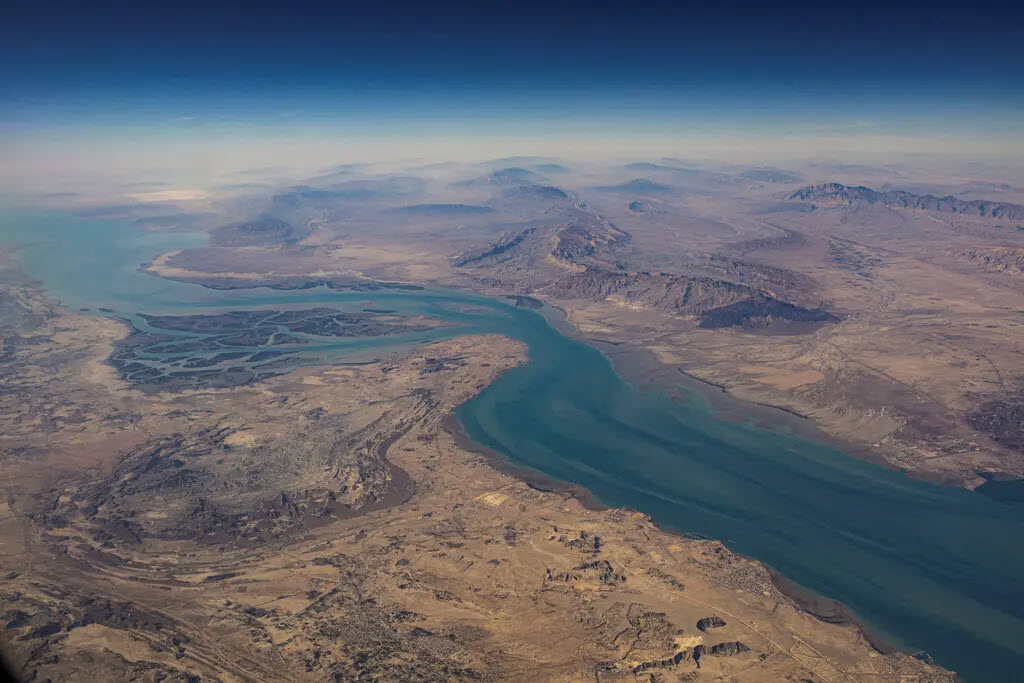
The Strait of Hormuz.
Iran’s new ayatollah – reportedly injured, possibly disfigured and not having made any personal appearances – has said that the Strait will remain blocked until the U.S. and Israel end their attacks.
CNN reported that multiple officials with knowledge of the Pentagon’s and National Security Council's planning of the military operation in Iran underestimated Iran’s willingness to close the Strait as retaliation for U.S. military action.
Hearing that, Hegseth was furious, recited CNN’s headline.
"Patently ridiculous, of course. For decades Iran has threatened shipping in the Strait of Hormuz. This is always what they do — holds the Strait hostage. CNN doesn’t think we thought of that. It's a fundamentally unserious report. The sooner David Ellison takes over that network, the better.”
Then why were we so unprepared with that eventuality? The U.S. is scrambling to figure out what to do. The White House’s preferred strategy is to escort ships through the Strait, but the Secretary of Energy Chris Wright says the U.S. is not prepared to do so, which says they had no anticipation of the Strait being closed. More ships are being sent to the region. For that purpose? Nor have they realized the disastrous vulnerability of that supposed “plan”. Not just because restoring the passage of oil to normality means escorting the 80 tankers a day that go through the Strait, but that Iran is mining the Strait and will attack our ships. America is unprepared for the shock of a U.S. Navy ship sunk with hundreds of lives lost.
Hegseth says about Iranians…
“They're exercising sheer desperation in the Straits of Hormuz. Something we're dealing with, we have been dealing with it. Don't need to worry about it.”
…which clearly says he knows nothing of what awaits. It is distressing that here, this publication, knows far more than the secretary of defense and the president. But here it is, what Let’s Fix This Country has known all along. If you want to know just how stupid this administration is, and what it is getting into, read what now follows — all of it, kindly. This ran in our January 17, 2012 issue under the subhead, “The Strait is no place for picking a fight”:
”The geography of the planet has always been a determinant of power and a decisive influence over the outcome of war.
There have been threats in the past to mine the strait or to sink ships to block its channels. The Chairman of the Joint Chiefs has mentioned using "minesweepers", but how would they cope with the far more advanced mine technology developed by China and Russia and, it is believed, supplied secretly to Iran? China, especially, has shown indifference to Iran's nuclear aspirations and is focused on Iran's oil.
That technology is alarming. There are mines that are virtually non-detectable, that can "swim" underwater just above the seabed for miles and be guided to exact geographical coordinates, where they will then drop and immerse themselves into the seabed. Pre-programmed to recognize the magnetic and acoustic signatures of specific ships, they can be fired remotely and from great distances. When fired, they do not simply explode but rather launch a missile at the identified ship directly above, or angled to within a certain radius. The Strait has been a subject of threat and counter-threat before, making it probable that Iran had reason already to have extensively mine the Strait with such highly advanced mines in preparation for a day such as this.
Do we think that Iran, naval maneuvers notwithstanding, would never confront the far more powerful U.S. Navy? Perhaps not, but there were reports in 2006, the last time the Hormuz choke point was in the headlines, that its Revolutionary Guard navy had prepared for a massive assault on international shipping in the Persian Gulf to disrupt trade.
Then there is the serious threat that ships have become vulnerable in the face of missile technology. The strait is reportedly targeted by Iran with anti-ship missiles. If an American carrier, with its crew of 5,000, were struck, it would mean all out war.
Not even missiles are needed. Four years ago, five speedboats taunted three U.S. warships entering the Gulf in a provocative action that almost drew our fire. Speedboats may seem to be no match for powerful naval ships, until one remembers that an even lesser suicide craft blew a hole in the destroyer USS Cole, when it was docked in Yemen in October 2000, killing 17 sailors. More ominous still, a war game conducted by our Navy in 2002 showed that warships are disturbingly susceptible to waterborne guerrilla tactics. In that simulation a Navy convoy lost 16 major ships, including an aircraft carrier, in a matter of minutes to a “swarm” of such speedboats.
An article in Foreign Affairs by Colin H. Kahl School of Foreign Service at Georgetown University's School of Foreign Service paints a still more alarming picture of Iran's preparations which are...designed to prevent advanced navies from operating in the shallow waters of the Persian Gulf. These systems integrate coastal air defenses, shore-based long-range artillery and antiship cruise missiles, Kilo-class and midget submarines, remote-controlled boats and unmanned kamikaze aerial vehicles, and more than 1,000 small attack craft equipped with machine guns, multiple-launch rockets, antiship missiles, torpedoes, and rapid-mine-laying capabilities. The entire 120-mile-long strait sits along the Iranian coastline, within short reach of these systems."
Iran has fitted itself out as a porcupine but neither Trump nor Hegseth show any knowledge of it.
painted into a cornerI might as well close on the mundane of Trump’s preoccupations. He has boasted of low gasoline prices for months, key to his promise to defeat inflation, yet seemingly had no realization of what his war would due to oil prices. Brent crude is $103 a barrel at this writing, up from $69 in mid-February. After proudly telling us of gasoline costing “$2.30 a gallon in most states, and in some places $1.99 a gallon” in his State of the Union address, the price at the pump has surged to a national average today of $3.675 a gallon.
To try to tamp down gas prices, Trump will draw down 172 million barrels from the Strategic Petroleum Reserve beginning next week, U.S. oil reserves, in coordination with all 32 member countries of the International Energy Agency, which “unanimously agreed” to release a combined 400 million barrels. Trump repeatedly criticized Biden for drawing on the reserve after the start of the Ukraine war. He says,
”We’ll do that, and then we’ll fill it up. I filled it up once, and I’ll fill it up again. But right now, we’ll reduce it a little bit, and that brings the prices down.”
The U.S. has been selling Venezuelan oil into the U.S. since late January, currently at the rate of 280,000 barrels a day in Trump’s attempt to lower gas prices at the pump. Most consequently, he has had the Treasury lift sanctions that have stranded Russian oil tankers at sea from delivering their oil, freeing our adversary to sell “hundreds of millions of barrels of crude” on world markets, says The New York Times. The Wall Street Journal reports that Russia’s oil has become “a hot commodity”. Just the week before, Russia had a problem finding buyers. But now, Trump has handed a priceless windfall to Russia — huge income to aid in its war against Ukraine, and this at the same time the U.S. is drawing down its weapons inventory, seriously crimping what might have been sent to Ukraine, thus dealing that desperate country a double blow.
Please subscribe if you haven't, or post a comment below about this article, or click here to go to our front page.