Says He Inherited Biden’s Inflation. What About His Own Contribution?
Dec 12 2025
Over ten months into his second term, President Trump has paid no attention to fulfilling the campaign pledge that is believed to have won him the election: the promise to bring down inflation and prices.
Until this week. Perhaps urged by aides that “affordability” has become the hot button issue for America’s families struggling to pay their bills, he staged a rally in Pennsylvania's Pocono Mountains. He had previously said, “The word affordability is a con job by the Democrats” and “a Democratic hoax”. But at the rally he was expected to execute a volte-face and acknowledge that, yes, there is a problem, and to announce a vigorous plan to battle high and rising costs.
But he didn’t. As someone for whom there’s never been a moment in his life when he’s lacked for money, he cannot make the transition into the lives of ordinary Americans. He fraternizes with other billionaires, including Treasury Secretary Scott Bessent, who of like mind said on “Face the Nation” last Sunday, ”The American people don't know how good they have it.”
So Trump continued to spoof the word ‘affordability’ at the rally:
”I say it and I said it the other day and a lot of people misinterpret it, 'Oh, he doesn't realize prices are high'. Prices are coming down very substantially, but they have a new word — you know, they always have a hoax — the new word is ‘affordability’."
…always said in a mocking tone. Behind him, a banner the width of the stage and printed cards held up by the audience proclaimed “Lower Prices” and “Higher Paychecks” as the crowd chanted “Four More Years”.
A quick run-through of what you probably already know to get to the larger point of today’s piece:
Prices are not "coming down very substantially". The price of oil and concomitantly gasoline has come down, but mostly during 2024 and only slightly since – from $3.02 a gallon a year ago to $2.99 now according to AAA. But other prices are rising – food up 2.7%, electricity up 5%, the two cost indexes felt day-to-day by U.S. households. There is nothing at play to prevent prices rising further. The soaring demand for electricity by the build-out of AI data centers will continue to force power companies to raise prices for needed funding. Businesses that initially absorbed tariffs will be factoring them more fully into prices. Trump’s tariffs work at cross purposes to any attempt to halt inflation. Given his election pledge, why ever did he impose tariffs on beef, coffee, bananas, and other tropical fruits, tariffs he belatedly realized he had to scrub? And now he is about to erect a 100% tariff on America’s everyday staple — pasta from Italy.
the inheritance“I inherited the worst inflation in history.” Mr. Trump says that repeatedly, and continues to do so well after being corrected. J D Vance faithfully supports the narrative. On Sean Hannity’s show ten days ago he said,
“We inherited a disaster… We inherited the worst inflation crisis in at least the last 40 years. I know that there are a lot of people out there, Sean, saying things are expensive and we have to remember they’re expensive because we inherited this terrible inflation crisis from the Biden administration.”
That’s more accurate, at least. It cordons off the inflation peak of 14.8% in 1980, 45 years ago.
Recent inflation peaked at 9% in July of 2022. But the inheritance was at only 3% when Trump returned to the presidency, and is 3% in the most recent report, with an update finally coing next week.
July was not the only month in 2022 reporting higher costs and those increases cumulated. Until rates subsided, the aggregate of those post pandemic year-over-year increases saw costs rise a good 20%. That elevated plateau of what everything now costs is what Trump inherited, and what he incessantly blames on Biden. So effectively does the media — left and right — by accepting the claim without reservation. Which is why, to correct the record, we’re taking a look at Trump’s contribution, which, of course, goes unmentioned by him, because it’s his inflation, too.
stimulantsThe closure or crippling of businesses brought about by the stay-at-home mandates of the pandemic left millions without an income. To keep the economy from collapsing, the U.S. government flooded the country with money.
 In March of 2020, Congress passed and President Trump signed the $2.2 trillion Coronavirus Aid, Relief, and Economic Security Act (CARES Act) with no thought given to how to pay for it. Trump signed off on another $900 billion that December. Joe Biden promptly added the $1.9 trillion American Rescue Plan Act in early 2021.
Direct cash payments to individuals were part of all three bills. Out went $1,200 checks (with Trump's name on them — unprecedented) 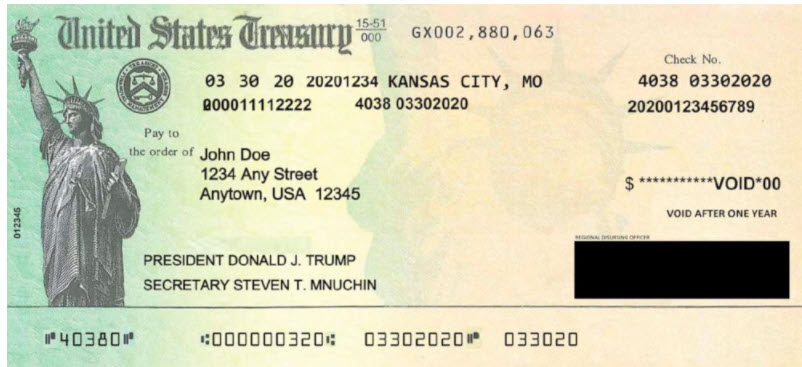
Check with Trump's name as first proposed. Final version had names side-by-side in smaller size
to every adult (and dependent) who earned less than $75,000 for singles and $150,000 for marrieds, the payout scaled down for those earning higher. Trump sent another $600 in January 2021 just before he left office. He had lobbied for $2,000 per person before the election. Not to be outdone, on taking over Joe Biden made up the difference with $1,400 checks in March 2021.
Three times over, the program sent checks to people irrespective of whether they continued to be employed. Checks also went to however many of the 69 million receiving Social Security were no longer working and suffered no income loss from the pandemic.
In total, a $3,200 gift from the Trump and Biden administrations. Cash totaling $817 billion was dropped into America's pockets.
The CARES Act provided $600 a week in unemployment payments spanning four months from April through July in Trump's final year, 2020. But the program was extended repeatedly, first by Trump and then by Biden, not ending until the day after Christmas 2021. The Treasury Department under Steven Mnuchin had quickly decided it was too complex and time costly to figure the amount 50 different ways so as to pay only the differential between $600 and the varied amounts and duration of eligibility of each state. The Treasury simply paid the full amount to everyone, which came to $678 billion.
The Paycheck Protection Program (PPP) provided $835 billion in loans to businesses, self-employed workers, sole proprietors, non-profits — loans that needn't be repaid provided the funds were used to cover payroll, rent, interest, and utilities. PPP's intention was to keep entities out of bankruptcy and people in their jobs, "But as the pandemic dragged on, Congress weakened those requirements, allowing companies to keep the cash even if they made deep staffing cuts", The New York Times reported in a 2022 analysis of where all the government largesse went.
As much as $80 billion — almost 10% — went to what prosecutors have called the biggest fraud in U.S. history. That’s on top of the $90 billion to $400 billion believed to have been stolen from the unemployment relief program — at least half taken by international schemers — as NBC News reported at the time. Investigators found examples of fraudsters buying "Lamborghinis, Ferraris, and Bentleys, and Teslas, of course, lots of Teslas" as well as mansions, vacations, and private jets flights to those vacations.
A ban on evictions to protect renters left some 11 million households with that much extra cash every month. Begun by Trump in September 2020, the moratorium was extended several times by Congress and Biden all the way to August, 2021, when it was finally ended by the Supreme Court ruling that the Center for Disease Control and Prevention (CDC) did not have the authority to ban eviction as a health measure.
President Trump immediately suspended student loan repayments as COVID began to ramp up in March 2020. Like eviction suspension, that left more cash in circulation to buy goods. Biden, mixed in with his many attempts to cancel student debt outright, inexcusably kept the moratorium going far past the pandemic, not ending it until October 2023.
All totaled, $5 trillion flooded the economy, making inevitable the inflation that followed once the pandemic subsided and goods returned to market. Sheltering at home from the scourge, unable to spend on services — restaurants, movies, travel — people shifted to homelife improvements — electronics, appliances, furnishings. But quarantine lockdowns made production sporadic. Accustomed to finding just what we look for on well-stocked shelves, we learned about supply chains and what happens when they are disrupted. Industry discovered that just-in-time inventory control, a quantum leap in efficiency, could have drawbacks; shortages developed and prices were bid up when trucks didn't show up at unloading docks. The shortage of semiconductors periodically shut down auto assembly lines. Used car prices shot up 37%. Lumber costs became prohibitive, adding $35,000 to building the average house. The median house sales price went to $346,900 in 2021, up 16.9% from the year before.the point Which is to say that the pandemic inflation had many causes but with Mr. Trump attempting to shift blame for the high prices he inherited as solely the malfeasance of Joe Biden's administration, we thought it in order to bring back a little history to show that his contribution to inflation was substantial.
Please subscribe if you haven't, or post a comment below about this article, or
click here to go to our front page.