The Iran War Reveals an America in Decline
May 15 2026America may be discovering that the disastrous war with Iran has reverberated far beyond Iran. After supposed “obliteration” of nuclear sites last June and, we are told, 13,000 strikes at Iranian targets this time, Iran shows no sign of yielding and has the upper hand with its control of the Hormuz Strait. Despite President Trump saying, “We’re the strongest nation in the world. We have the strongest military by far in the world”, and about Operation Epic Fury, “It’s going to work very easily”, we have demonstrated that our military is less dominant than the world may have believed.
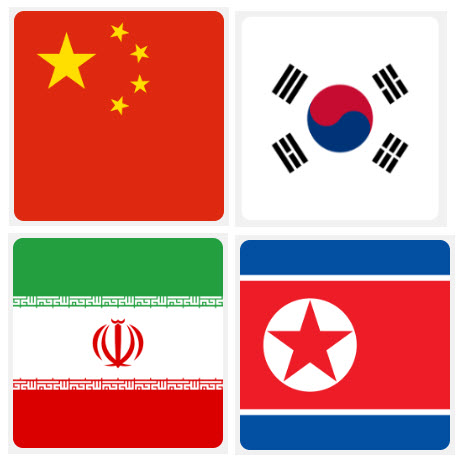
The article later discusses the four nation
axis out to supplant the U.S.as a world
superpower.
Early in the conflict, Defense Secretary Hegseth said Iran’s missile and drone programs are being “overwhelmingly destroyed”, that the joint U.S.-Israel attacks had “decimated Iran’s military and rendered it combat-ineffective for years to come”. The President described Iran’s arsenal as reduced to only about 18% or 19% of prewar level.
But it was soon reported that more than half of the country’s missile launchers are still intact as well as thousands of one-way attack drones. Just this week a worse report: A secret intelligence assessment told lawmakers that roughly 90% of Iran’s underground missile storage and launch facilities nationwide are assessed to be “partially or fully operational”, and that Iran still has about 70% of its estimated 2,500 prewar missile stockpile. Worse of all, Iran has restored operational access to 30 of its 33 missile sites along the Strait.
inventory drawdownThe U.S. is looking at greatly diminished stockpiles of weapons. It has expended about 1,100 long-range stealth cruise missiles, over 40% of its original supply going into the war. It has sent off over 1,000 Tomahawk missiles – roughly “10 times the number the Pentagon procures in a year”, says a New York Times rundown. The 1,300 Patriot missiles we have fired to intercept incoming from Iran is two years of production. Add to that the Center for Strategic and International Studies estimates of other interceptors depleted: half of high-altitude THAAD missiles, 25% of SM-6 and 50% of SM-3s interceptors, and around 25% of stealthy, armor-piercing air-to-surface JAASMs.
All manufacturers plan to ramp up production. This need has been foreseen for years, but met with inaction. It will take some three years to arrive at minimally needed production levels. That assumes Congress will appropriate the funds – the Defense Department is asking for $1.45 trillion in its budget request, and that does not include extra billions needed to cover the cost of the Iran war.
The U.S. has been the hegemon of the Gulf, turning back Hussein's invasion of Kuwait, feeding money and weaponry to Israel, taming Iran with the JCPOA agreement until Trump in his manifest ignorance tossed it in the trash. As Reuel Gerecht and Ray Takeyh write at The Wall Street Journal:
”The Gulf Arab economies were built under the umbrella of American hegemony. Take that away — and the freedom of navigation that goes with it — and the Gulf states will ineluctably go begging to Tehran.”
The nature of warfare has become low cost missiles and drones that finds the U.S. still fighting with its hugely expensive aircraft carriers and fighter-bomber jets. The U.S. underestimated Iran’s, having no satellites of its own, ability to strike with pinpoint accuracy, which said that China and Russia are backing Iran with surveillance satellites and intelligence. In unprecedented strikes against fellow Muslim nations, Iran targeted the UAE, Saudi Arabia, Kuwait, Bahrain, and destroyed 17% of the world’s largest liquid natural gas export plant in Qatar that will take five years to bring back on line.
stalemateAnother wave of attacks by the U.S. against an unyielding Iran would leave America's magazines nearly empty – stockpiles that were meant for a possible war with principal adversary China when it attempts a takeover of Taiwan, stockpiles that were already inadequate before the Iran depletion.
A desperate measure would be the destruction of Iran’s oil export hub at Kharg Island. The fear is that Iran would retaliate by destroying the counterpart facilities of all its neighbors, causing a worldwide energy catastrophe.
Other than diplomacy, that leaves the blockade, which ties up some 30 U.S. warships indefintely, and which Iran could withstand for another three to four months before facing economic collapse, in the CIA’s estimation. A U.S. official who spoke to The Washington Post thought Iran’s capacity to endure prolonged economic hardship is far greater than even the CIA estimate:
“The leadership has gotten more radical, determined and increasingly confident they can outlast U.S. political will and sustain domestic repression to check any resistance.”
Besides, a regime that killed a possible 30,000 protesters would not be concerned with subjecting the Iranian people with economic hardship. One possible breakthrough is that Iran is running out of storage capacity for the oil it is prevented from exporting. Tehran might relent faced with shutting in wells which can render them inoperable.
If the Strait is ever returned to normal, Iran knows it can hold the world energy markets hostage — resume tolls, choose which ships of which countries may pass through, impose demands at will, with those missile launchers along the shoreline poised to demand obedience.
less is lessThe outcome is that Israel and the Arab nations see the U.S. as a diminished superpower tied by Iran in a Gordian knot it knows not how to unravel. The nations of the region have always counted on the U.S. to come to their aid and thwart any aggressor, but now they are dismayed to find their protector has come up short of its ability to do so, and will probably be disinclined to continue.
The U.S. military can do a lot of damage, but doesn’t look ahead how to finish. Think of Iraq. Think of Afghanistan. Now, another quagmire. Conservative journalist Christopher Caldwell in a New York Times opinion piece thinks Netanyahu got it right: He saw that prospects for enlisting U.S. firepower were dwindling, that "Mr. Trump’s gullibility provided Mr. Netanyahu with a last chance". And now the Arab countries realize they must finally learn how to fight for themselves.
adversaries are watchingThe axis of China-Russia-North Korea-Iran has undoubtedly become more emboldened by the U.S. inability to force Iran to capitulate while squandering so much of its ordnance in the process. China now questions whether the U.S. is capable of defending Taiwan. The Iran war has exposed that America cannot produce weaponry at a rate sufficient to wage a sustained conflict. Our aura of supremacy has faded.
China President Xi Jinping pressed Trump this week not to go through with the planned arms sale to Taiwan. Trump, in the first time for an American president, appears to have equivocated support for the beleaguered island nation. To not become a combatant in the defense of Taiwan is an argument for futility, but to abandon assistance altogether would be yet another America betrayal, casting adrift in the bargain our allies in the region: Japan, South Korea, the Philippines, Australia. China’s conquering of Taiwan would add the straits between Taiwan and the Chinese mainland to China’s control of the South China Sea. It would effectively dislodge the U.S. from the western Pacific.
The four countries support each other in their common animus toward the U.S. Iran has supplied Russia with its top-of-line drones for its war against Ukraine. China is bankrolling 60% of that war and has even “discreetly built supply lines going to drone factories in Russia”, according to British military. All of the four are fitted out for war with nuclear weapons and millions of men in arms. They pose an indomitable threat to a U.S. buried in debt exceeding $39 trillion and a president who has destroyed our alliances around the world, telling Europe it is on its own with NATO, leaving the U.S. isolated. Their overarching objective is to supplant America as the world's leading country, to leave it isolated in this hemisphere. China intends to be the world's only superpower hegemon and America no longer has the strength to stop it.
Please subscribe if you haven't, or post a comment below about this article, or
click here to go to our front page.