Let's Fix This Country
the economy

Where Will the Jobs Come From? »

Can we ever return to full employment? Nov 17 2012

The election is over but the central problem remains: millions cannot find jobs.

The Republican creed says that the government doesn’t create jobs, that lower taxes and less regulation are what will free market forces to create jobs. The wealthy are the “job creators”, so leave more money in their hands.

Democrats believe government programs — education, infrastructure, etc. — are needed to spur job growth and that those already well off should contribute more in taxes — their “fair share” — to make that happen.

Both assume that jobs are out there, like seeds in the soil, needing only a little sunshine and water to bloom. But what if neither are correct? Is there a darker truth that neither political parties nor the presidential candidates had dared voice?

pulling back the curtain

The subprime mortgage crisis in 2007 that led to steep job loss and the ultimate crash in 2008 caused America to notice seemingly for the first time that much of its prosperity was an illusion.

For decades we had been paying for the good life with unearned money. Banks promoted homeowners to trade the equity they had built up in their homes for renewed debt — home equity loans. Buying on credit had largely replaced money, with credit card debt building constantly right up to the economic collapse, peaking at $972 billion in September 2008. The stock market added its good vibrations, with the S&P 500 multiplying 15-fold from 1980 to the dot.com plunge in March 2000, and rising again to that same level in July 2007.

There was speculation that housing prices might never stop rising, spurred by interest rates held low by the Federal Reserve that caused people to refinance and spend the new-found gains. Fed Chairman Alan Greenspan had even encouraged us to buy houses using adjustable rate mortgages, praising lenders in a 2005 speech for offering a greater variety of "mortgage product alternatives" other than fixed-rate mortgages. “It was quite a system”, said Nicholas von Hoffman, in The New York Observer:

“You bought a house on a next-to-no-money down basis, the house increased in appraised value by 10% even before the first load of dishes got put in the dishwasher. You refinanced the house to extract the 10% appreciation and spent it on a vacation, and by the time you’d returned from the camping trip to Colorado or the Kalahari Desert, the value of the house had gone up another 10%”.

That prescient 2005 article went on to forecast the housing collapse and “voilà recession”.

Then came that collapse. Everything fell back to earth. No more house to borrow against, with their value plunging 28% below peak, ending the seemingly inexhaustible wellspring that had supplemented wages.

The new reality woke us with a cold shower of uncomfortable facts — facts that had gone unnoticed for decades, masked as they were by an illusory prosperity. We were told that, except for the upper income groups, Americans had not done all that well during the late decades of the last century. In the 45 years since 1967, the median income of the American male had actually flatlined, according to the Census Bureau. Adjusted for inflation, he earned $32,694 in 1967 and $32,986 last year. Average household income for the bottom 60% of all Americans had risen by only 17%, and most of that rise had come from the early years. Since 1980 household income rose only 6% (and has fallen by 11% since 2000). That household income has risen at all is because women entered the work force. They have seen their income double during the period, but to a median of only $21,000.

That the rest of households — the top 40% — fared much better has become common knowledge, with income rising 58% since 1967 (88% for the top 5%). But today there are 104 million people — a third of the population — who have annual incomes less than $38,180, which is twice the poverty threshold for a family of three, says Census Bureau bureau data.

the global playing field

What are the causes? Globalization has certainly taken its toll on American working class wage earners, vulnerable for enjoying a much higher pay envelope than the rest of the world. When low cost global telecommunications made possible the outsourcing of low level jobs such as call centers, companies quickly realized that white color work such as software coding, accounting, legal research, even x-ray and scan evaluation could also be transplanted to the other side of the world. Then one of every three manufacturing jobs — almost 6 million in the most recent decade alone — disappeared. American companies relocated facilities to foreign shores to take advantage of lower wages, and in some cases, the hundreds of thousands of engineers churned out by countries such as India and China, whereas American youths were going to film school and majoring in "communications". All these realignments have combined to eliminate jobs in the U.S. and suppress the wages of those that remain.

there to stay

There’s no going back. U.S. multinationals have developed worldwide supply chains for commodities, engineering, production, parts and assembly and are increasingly decoupled from the U.S. They will simply move elsewhere if tax or other legislation attempts to short-circuit these elaborate networks. They’re doing fine selling to markets everywhere and are increasingly indifferent to the travails of America’s labor force, exemplified by that Apple executive who said, "We don't have an obligation to solve America's problems."

How could the results of globalization been any different? Free trade between rich and poor nations has the inevitable leveling result of cutting the living standards of the former while raising those of the latter. U.S. multinationals have eagerly promoted globalism and membership in the World Trade Organization so as to gain entrance to foreign markets but with little concern for the obliteration of U.S. industries such as electronics and textiles.

And so, in the United States, those fortunate enough to find employment found themselves taking substantial pay cuts in comparison to the jobs they formerly held. Worse still, Louis Woodhill at Real Clear Markets peels back the job numbers to show that so many of the jobs heralded by the Obama administration are only part-time — 403,000 of the 559,000 added in the last quarter. He could have added that if part-time jobs are not counted as what he calls “decent” jobs, the unemployment rate would be more like 15%, and that still doesn’t count those who have given up looking for work. There is concern that this trend will intensify when Obamacare takes full effect, that businesses will hire two part-timers to avoid the requirement of buying healthcare for one full-time employee.

While manufacturing jobs were being outsourced to low wage countries, we shrugged that off; we decided we’d be a “services economy”. Then “information economy” sounded better. Economists in the '80s and early '90s said we should not bemoan the loss of mundane jobs to other countries, because this freed the newly unemployed to shed numbingly repetitive factory floor jobs and move up a level to higher skilled and higher paying work. That has again become the theme, with new emphasis on retooling ourselves to stay competitive by learning math and engineering or technical training at community colleges.

There has always been a fallacy to the economists’ argument, and not just that so many of those higher paying jobs have also moved overseas. The fallacy is that, the higher up the skill ladder one goes, the less jobs there are. It’s a pyramid, with fewer jobs at each level, which seems never to have occurred to those optimistic economists, so often lost as they are in theory. Thousands once manned the factory floors, for example, but the engineers and designers of the products they built numbered only in the hundreds.

One need only look at today’s super-growth stars for examples. The New York Times last year made the point that all the employees at Facebook, Twitter Groupon, Zynga and LinkedIn — companies with a collective market value of about $170 billion at the time — could all fit in a basketball arena. Facebook this year bought Instagram, a San Francisco company, for $1 billion. It had 13 employees. From presidents to pundits we hear about America’s prowess in “innovation”, but what if most innovation comes from companies like these, providing relatively few jobs — and those held by highly skilled engineers?

doing with less

Several forces are aligned against job creation. With Americans having less to spend in the recession and worriedly paying down debt with what money they do have, the economy has lacked the demand to spur American businesses to hire and ramp up production. Major U.S. corporations instead wait on the sidelines while some $1.7 trillion accumulates. And now along comes the year-end “fiscal cliff” as if to persuade them of how wise their reticence has been. There is widespread fear that, barring action by Congress and the President, the simultaneous reversal of all Bush tax cuts, the rise of payroll taxes to normal, and the “sequester”’s cutback of $100 billion or so in defense and other spending will combine to reprise the recession.

It’s not only lack of demand and abundance of uncertainty that has stalled hiring. The recession has taught companies that they can make do with less employees. They've discovered productivity of a different sort. The Wall Street Journal reported that revenue per employee at S&P 500 companies rose from $378,000 in 2007 to $420,000 in 2011.

rage against the machine

When they do decide to add to production, compared to the ongoing cost of paychecks and employee benefits, corporations are finding that the math of investing in ever less costly robotics is compelling.


And the machines have become ever more adept. Software and tooling now make it possible for those groping arms on auto assembly lines to perform three or four jobs, not just one. And robots have been developed to work far faster and perform delicate operations, such as those in the photo which, each of which says this New York Times piece on robots,

“endlessly forms three perfect bends in two connector wires and slips them into holes almost too small for the eye to see. The arms work so fast that they must be enclosed in glass cages to prevent the people supervising them from being injured.”

That means robots can soon take over small appliance assembly, displacing even Chinese workers. The number seems preposterous, but the CEO of China’s Foxconn says he plans to install more than a million robots. He equates Foxconn's million employees with animals and "to manage one million animals gives me a headache.”

the cost of efficiency

The inefficient mom and pop stores on main Street are long gone, replaced by big box stores that left mom and pop to find work elsewhere, but Wal-Mart needed only so many greeters (and has dispensed even with them). Chains of warehouse-size stores have brought us imported goods at much lower prices, but they need less workers and the outflow of jobs to the foreign producers who fill store shelves has left fewer of us with the money to buy the goods — a downward vortex.

To displace or cannibalize those stores have come the online distribution center companies, the largest being Amazon, that operate with far fewer employees than the stores. Some months ago Amazon paid $775 million for Kiva Systems, which makes robots that roam warehouses, picking goods off the shelves to make up orders — work formerly done by people.

At least online ordering creates jobs in the delivery companies. But vision technology is coming in newer robots that can sense shapes of boxes so as to pull a box from a shelf and rotate it into position with boxes already collected so as to form an optimal cube for binding with plastic wrap. As their cost drops we can expect such machines to be adopted by companies like United Parcel Service and Federal Express, where wage earners in the tens of thousands now do the job.

We are developing an economy of surplus people. And we are all doing our part. First we learned to use ATMs, thinning the ranks of bank tellers. Ticket booths are gone; we buy subway and railroad tickets from machines. We pump our own gas. Supermarkets and chains like Home Depot now have us do our own checkout, eliminating those jobs. We book airline flights ourselves and even print the tickets. Getting us to do the chores is another way companies increasingly divorce the connection between increasing profits and hiring people.

failure of imagination?

Politicians and economists regularly assume that innovation and new ideas will create industries we cannot even imagine. But there’s an argument that The Next Big Thing has already been invented, at least as pertains to job creation. Think about it. Just what more is there that we all need? A currently running commercial tells us that we can now hand off our playlists to friends, phone to Bluetooth phone. Miraculous, but hardly essential to life, or life-changing, as were the inventions of locomotives, automobiles, planes — or appliances such as washing machines, for that matter.

Rana Foroohar ends a recent column in Time with: “Whoever ends up in the White House will have to grapple with the fact that growth may never be what it once was”.

So we are left with the question: Where in the future will we find jobs for tens of millions of people?

Give us a try. Subscribe!

All we need is your e-mail address. Every ten days or so we'll send you a heads-up when we have new material. Simple. Free. Ask us to stop any time. And we'll never give your address to anyone. Just click Subscribe at top left above. The subscriber count matters in the blogosphere. Your subscribing tells us to keep going.

Doubling Down Against Retirees »

The Fed's emphasis on jobs puts the squeeze on seniors Jan 8 2013

Sharia law prohibits charging interest for loans of money. Capitalism has a rather different view. It says that if we manage to accumulate money through our efforts, we should earn something if we give someone else the use of that money.

Ben Bernanke and his Federal Reserve seem to prefer Sharia law. The Fed has forced down interest to the vanishing point — driven to virtually zero since late 2008 when the Fed moved to counter the crash.

Americans are notorious for saving next to nothing, but those seniors had had listened to advice about saving and had carefully tucked away money for their retirement in the expectation that those funds would earn them interest income to live on have been harshly disappointed. Bernanke decided to reward the banks instead — those financial institutions whose risky behavior had played an instrumental role in igniting the 2008 financial panic.

The Federal Reserve has kept interest at 0% or thereabouts so that the banks can borrow money from the government at next to no cost. The idea is that they will then have cheap money to loan to businesses and homeowners who in turn will use it to re-start the U.S. economic engine.

Funny thing happened, though. The banks had already used bailout money to swallow other banks or buy back their own stock rather than make loans. Now they simply use the 0% money to buy Treasury notes that pay higher interest than the interest cost of the money they borrowed from the government. Or they bet the money in the worldwide casino of the derivatives market. Trading is what banking has become. That has proved much more rewarding than the mundane business of loaning to businesses, financing car loans or writing mortgages.

money for nothing

Zero interest isn’t working all that well to regenerate the economy, but the Fed won’t give it up. So retired people who place their money in the safety of Treasuries are, as we've said before, loaning money to the government for free. They get nothing back, nothing to pay their bills. Fed policy effectively asks them to to risk their money elsewhere — exactly what older people are told not to do.

If a lack of consumer demand is one cause for stalled hiring by businesses, the irony is that the Fed program has been somewhat self-defeating, especially among seniors. With less money to spend, they’re spending less money, scrimping on everything. Of the 78 million baby boomers, each new batch of 10,000 who retire every day are hanging onto what money they have in a feedback loop that helps keep demand from rising.

opening the hydrants

Because zero interest isn’t working, the Federal Reserve has tried a second approach — pumping huge sums of money into the economy in the hopes that might turn over the sputtering economic engine. The program is shrouded behind the bewildering name of “quantitative easing” (QE) but a valid enough translation is “printing money”.

There have been two such surges — $600 billion injected into the economy beginning in November 2008 after the September crisis, and another $600 billion starting in August 2010.

The third QE began a few months ago when the Fed declared that, rather than huge dollops of occasional money, it would buy $45 billion in Treasuries every month from the banks that routinely invest in them. As payment, the Fed issues credits to the selling banks — effectively printing new money because the credits are money that doesn’t exist. But these IOU’s from the Fed are treated as increases to bank reserves, which frees up money for them to lend.

Or so goes that theory which doesn’t seem to be working. And because it hasn't, the Federal Reserve has now doubled its outlays, adding $40 billion a month of mortgage purchases to the $45 billion a month in Treasuries.

The idea is to reduce the supply of Treasuries and mortgages so that sellers of those instruments can dictate still lower interest payments to buyers, who still need to place America’s vast sums of money somewhere, anywhere that at least pays something. That’s how the Fed puts its foot on the throat of interest rates to pin them to… Read More »

the economy

Does Anyone Know What To Do About Jobs? »

Jun 28 2012

Screenwriter William Goldman (“Butch Cassidy and the Sundance Kid”, etc.) is often quoted for saying about Hollywood, “No one knows anything”. The comment was wasted on Hollywood. He should have said it about government and its notions of how to cure unemployment.

The desultory jobs numbers paint a grim picture of the American economy and diminish Barack Obama’s prospects for re-election. Mitt Romney, who has pulled ahead in recent polls, believes his experience at Bain Capital gives him a better understanding of what is needed to restore the nation to prosperity, and voters may turn to him for answers. Barack Obama’s answer to Romney: “If your main argument for how to grow the economy is ‘I knew how to make a lot of money for investors’, then you’re missing what this job is about”.

The fact is, neither has the answer. Presidents have a limited role in creating jobs, and we are foolish to give them credit for the good times and blame them for the bad. The roots of today’s problem lie much deeper. But in-depth analysis is not how we pick our presidents.

The Republican leadership calls every action by the Obama administration “job killing”, especially any proposal to tax “job creators” (both phrases apparently must be inserted into every sentence), and the President tours the country railing at the obstructionist Congress. Nothing goes forward.

The Republican strategy has been to throttle every attempt by Obama to produce jobs, and then to blame him for causing persistent high unemployment. They have successfully portrayed the 2009 stimulus as a failure and for the most part have stifled any job program in the three years since. Obama went before a joint session of Congress last September to propose his American Jobs Act, repeatedly exhorting its members to “pass this bill”, but it would be pronounced “dead” by Republican Majority Leader Eric Cantor just weeks later. Blocking Obama is in keeping with Senate Minority Leader Mitch McConnell’s crusade that “the single most important thing we want to achieve is for President Obama to be a one-term president."

It is remarkable how well the strategy of casting blame on the Obama administration seems to be working. All the while, a budget passed by the Republican-controlled House with deep cuts guaranteed to cost jobs in the hundreds of thousands goes unnoticed.

For his part, Obama has always played small ball, scaling back his initiatives so as hopefully… Read More »

the economy

Socialism? They Must Be Kidding »

Mar 17 2013 This riveting video turns the income and wealth of all strata of Americans into a vivid set of graphics that is nothing less than astonishinng in showing how badly skewed is America in favor of a small segment of our society.


Not to be missed (sound on). This is one case where we all really should forward this to everyone we know to get rid of the nonsense we hear about creeping socialism. We are in the midst of the extreme opposite.
policy

Food Stamps, Meet the Minimum Wage »

One high, the other low. Congress never makes the connection Feb 24 2013

Food stamps come in for particular ire from some. Over 46 million Americans pay for their groceries with federal food stamps. Half of the mouths that food stamps feed belong to children. It is a 40-year-old program (renamed “Supplemental Nutrition Assistance Program” or SNAP) but only in recent years has it ballooned to one in seven people, currently costing taxpayers $72 billion a year.

The rapid increase owes partly to the weak economy that has followed the financial crisis of 2008, but also to a loosening of the eligibility rules to assist the victims of that economy. It is no longer required that a family sell off all its assets and belongings to qualify, for example.

But Congress sees only the cost. Food stamps are part of the perennially stalled farm bill, which comes up every five years. Congress has repeatedly passed temporary bills with sunset clauses. A mare’s nest of subsidies from crop insurance energy, telecommunications, forestry — you name it — the current extension expired last September 30. Since then we have therefore technically reverted to the last permanent bill passed as law — in 1949. You read that correctly.

It may be a farm bill but food stamps make up 79% of the near trillion dollar ten-year bill the Senate passed last June. (Yes, June, and it is now January with nothing having been passed). They cut $4.5 billion from food stamps. House Republicans want to cut $16.1 billion, which would drop about three million Americans out of the program. but their bill has never made it to the floor for vote because of those who say cuts are not deep enough.

The swelling numbers in people and dollars says to conservatives that the program is out of hand. The Wall Street Journal’s editorial page is representative. An op-ed piece said about food stamps, “thanks to Obama’s stimulus, [the cost] doubled again between 2008 and 2012”, without mentioning that the stimulus aid was brought about by millions thrown out of work by the 2008 financial crisis that took food off their tables. Another is entirely about the military but has the gratuitous title “Defense vs. Food Stamps: What Would You choose?”. Or the editorial titled "Food Stamp Nation" which called food stamp recipients those “who who depend on taxpayers to buy one of life's most basic responsibilities. It's a good thing breathing air is free”.

Even these parsimonious scribes might soften their critiques were they simply to divide the annual cost by the number of recipients — cited as $71.8 billion and 46,670,373 in that very same editorial — and then the result by 52 and they would discover that the amount per person per week is to die for — literally — $29.59.

Cory Booker, the mayor of Newark, NJ, a city of 277,000 with 74,000 on food stamps, tried living on them for a week to see what his constituents were experiencing. And true to our math experiment, he got a meager $29.78 for a week of groceries. It was a week of nothing but salad, beans and broccoli, hunger pangs and fearing he would run out.

cause and effect

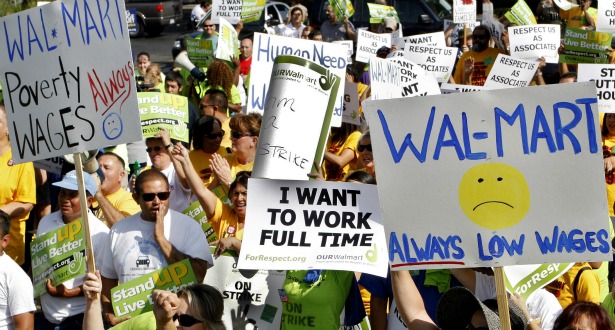
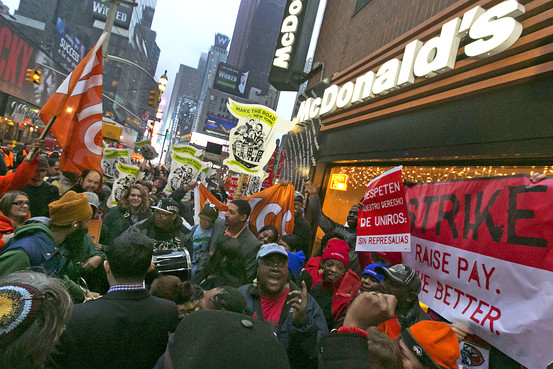
Here’s a hypothetical. If you think too many people are on the food stamp dole, wouldn’t their ranks diminish if those with low-paying jobs made more money? Yet all too often those same people who harangue about food stamps are those who inveigh against raising the minimum wage.

Now, it is true that the minimum wage would have to be raised quite a bit for someone to no longer need food stamps, which reflects on how far below the cost of living is today’s minimum wage of only $7.25 an hour.

No one can live on that. Assuming a 40-hour work week (and no vacation), it comes to $15,080 a year — less if no pay for holidays and sick days. Somehow, less than $1,300 a month is supposed to pay for rent, food for children, light, heat, getting to work — and let’s hope no one gets sick. Our legislators are seemingly content to leave on the books a minimum that for a single mother with two kids is $4,000 below what is considered the poverty level by that same government. It is a wage that approaches slavery. If you find that an outrageous statement, consider that slaves, while paid nothing, were given shelter and food, which the minimum wage earner must pay for.

Yet whenever the issue is raised in Congress a chorus of business lobbyists descend on the Hill with money and dire predictions of inflation and calamitous job losses. When the rate was raised from a truly Dickensian $5.25 an hour in 2007 to today’s $7.25, was there inflation? Those opposed rely on numerous surveys of economists who, schooled by a canon that says when anything goes up, something must come down, have reflexively agreed that a minimum wage’s mere existence must increase unemployment among low-skilled workers.

But those are just surveys of opinion. Actual studies say otherwise. Economists at the University of Massachusetts-Amherst “compared employment levels in contiguous areas with disparate minimum-wage levels over a 16-year period and concluded in a 2010 paper there are ‘strong earnings effects and no employment effects of minimum wage increases,’” according to commentary at Bloomberg/BusinessWeek, and studies before that have found employment effects to be slight.

If so, and employment remains stable after increases in the minimum wage, then opponents can legitimately make the case that prices must rise for all of us in order for businesses to recoup the cost. What’s wrong with that? Should our pockets be subsidized by holding the pay of those who produce the goods and services that we buy at a misery level?

downhill since 1968

The President, in his State of the Union, wants to raise the minimum wage to $9.00 an hour (down from the $9.50 he once proposed). A Zogby Analytics poll found that 70% of Americans (and 54% of Republicans) support raising the minimum above $10 an hour.

And that still leave us short of the adjusted for inflation $10.51 an hour minimum of 1968, from which we’ve fallen short ever since. We have the lowest minimum wage of any major western nation. In Australia it is over $15, France over $11, and most of those countries pay for health care.


The blue shows the nominal minimal wages across the years since
the first law passed in 1938. The red data points show those same rates
adjusted for inflation, with 1968 equal to $10.51 an hour and both series
arriving at today's $7.25. The chart is from the University of Oregon.


Fox Business refuted the need for an increase by indirectly citing a study by economists at Miami and Florida State Universities who found that two-thirds of those hired at the minimum wage get a raise in their first twelve months, as if to say there is nothing wrong with a year at poverty wages and without mentioning whether the average raise was enough to lift them out of poverty.

Eighteen states have broken with the federal government and raised the minimum beyond $7.25, but the increases are mostly slight, and the highest is $9.04 in Washington State.


Source: U.S. Department of Labor

Every dollar paid to a minimum wage earner is spent; it goes back into the economy. At that pay level, nothing goes under the mattress. Every cent is needed for the necessities of life. Every dollar of increase to that wage adds close to $2,000 per worker of further spending into the economy. And studies have also found that a minimum wage increase tends to push up wages of those earning more than the minimum, as business owners try to maintain hierarchies of pay grades.

Yet our lawmakers continue along two separate and conflicting tracks, holding the minimum wage at a brutish level while wondering why so many need food stamps. Were Congress to make that connection, they might find that forcing pay increases would cut the need for the food stamps that some so dislike. Or is that asking for logic beyond their pay grade?