Trump Surrenders to Iran on Terms Humiliating for U.S.
< war|373||>
President Trump is closing out his career as a brilliant businessman with yet another bankruptcy, this one at colossal scale, and he’s taking the United States down with him. In the Memorandum of Understanding (MOU) with Iran, our master deal maker is revealed even to his MAGA base as totally inept.
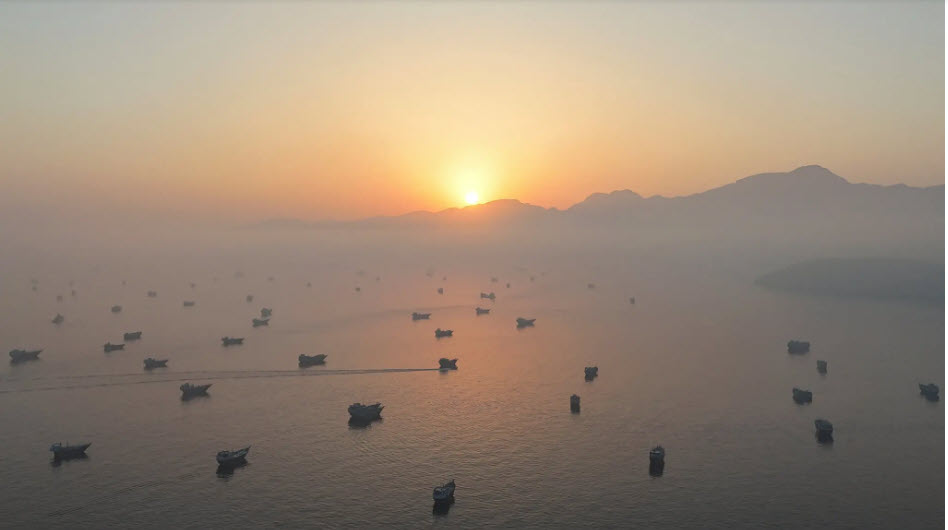
Dawn on Strait of Hormuz .
The document calls for certain immediate actions, but then allows 60 days for the two sides to arrive at final terms in accord with the MOU. That deadline is “mutually extendable”. Given that negotiations for the Obama 2015 agreement took two years, we may well see Iran stalling interminably again. Meanwhile, here’s what’s in the MOU:
Uranium Enrichment: An end to Iran’s upgrading of uranium on their path to creating nuclear weapons was the overarching intention of the war. The memorandum calls for the following:
”The United States of America and the Islamic Republic of Iran have agreed to resolve the disposition of stockpiled enriched material pursuant to a mechanism that will be mutually agreed upon…with the minimum methodology to be down blended on site under the supervision of the IAEA.”
This will happen according to a schedule yet to be worked out. The IAEA is the International Atomic Energy Agency which has always served the role of inspector of Iranian compliance.
Trump touted as a major accomplishment getting Iran to pledge not to produce a nuclear weapon. The MOU says:
”The Islamic Republic of Iran reaffirms that it shall not procure or develop nuclear weapons.”
Note reaffirm, because the 2015 Joint Comprehensive Plan of Action (JCPOA) struck by the Obama administration and cancelled mindlessly by Trump in 2018 had already exacted that promise. It said:
“Iran reaffirms that under no circumstances will Iran ever seek, develop or acquire any nuclear weapons”
The Trump negotiators, Vice-President JD Vance along with real estate guys Jared Kushner and Steve Witkoff , failed to get “acquire” into the pledge, which is not what “procure” means.
That’s all the U.S. got, and to get only that, in place of the “unconditional surrender” that Trump initially demanded, it is the U.S. that has surrendered, and with few conditions in its favor. Trump and his negotiators have showered upon Iran a cornucopia of concessions painful to read:
The Hormuz Strait: “Immediately” upon signing of the MOU, the U.S. is to withdraw its blockade over 30 days while Iran engages its…
“best efforts for the safe passage of commercial vessels with no charge, for 60 days only”
Iran will consult with Oman, on the opposite shore, along with other Persian Gulf littoral states, “to define the future administration and maritime services in the Strait of Hormuz”, which clearly means the imposition of tolls (“fees”, Iran has called them) for these euphemistic “services”.
In a curious phrase that sounds like Iran has in mind slow-walking the Strait’s clearance, the traffic allowed to others will only be in proportion to the amount of restored Iranian commercial traffic.
Sanctions: The U.S. is agreeing to “terminate all types of sanctions” somehow even those it does not control, such as by the United Nations Security Council and the IAEA. There seems nothing our negotiators won’t agree to, so desperate is Trump to get out of this war. This is to be done in accord with an “agreed upon schedule as part of the final deal” 60 days hence, but then comes this utter capitulation:
Oil: Right away, in return for nothing, even before sanctions are to be lifted as part of the final deal,
“US Department of Treasury will issue waivers for the export of Iranian crude oil, petroleum products and derivatives, and all associated services, including banking transactions, insurances, transportation”
Wasn’t Trump going to take Iran’s oil?
Frozen Funds: In another giveaway in return for nothing as yet agreed to, the U.S. is to release Iran’s frozen and restricted funds. How much might that be? Iran says a hundred billion measured in dollars. The funds are to be made available “for payment to any ultimate beneficiary designated” by Iran’s Central Bank. Will we see their bank ordering the U.S. to make out checks to Hezbollah, or the Houthis, or Hamas? Once again, as with the JCPOA, the memorandum makes no attempt to restrict Iran’s funding of terrorist groups.
Reparations: The stunning provision that has even Republicans meekly voicing “concern”, after a decade of silent acquiescence to all things Trump, is that the U.S. is agreeing to pay reparations. With “regional partners”, we are to come up with $300 billion for a “mutually agreed plan” for reconstruction and economic development of the enemy country.
Our supposed “regional partners” are not party to this deal so their funding of reparations is not only voluntary but absurd to contemplate, after being attacked by Iran, and yet Trump believes each country should be in his debt for taking on Iran.
Status Quo: A final item: Pending the final deal, both countries agree to maintain the status quo, specifically the status quo of Iran’s nuclear program. Iran could go right on upgrading uranium above 60% well beyond the “mutually extendable” 60 day deadline.
obsessed with obama
Jealous of his popularity, Trump has been avid that his deal will be better than President Barack Obama’s, which he calls “disastrous” and “one-sided”. Just before the MOU’s release, he tweeted:
“The Obuma Deal was a road to a Nuclear weapon for Iran, cash and all, one of the worst and dumbest (hence Dumocrats!) Deals ever made by the U.S. Our Deal is a WALL against Iran ever having a Nuclear weapon, the complete opposite of Obuma.”
(The juvenile misspellings are his.) In his ignorance and mania to destroy all things Obama, Trump was unaware that Iran had been conforming to the JCPOA, as attested by IAEA, for the three years before he heedlessly cancelled U.S. participation in the six-country agreement. Iran was not on “a road to a Nuclear Weapon”, with its uranium stock reduced from over 7,000 kilograms to 300; bled down to only 3.67% on the enrichment scale; and left with only first generation centrifuges. Left to continue, this could have been the status for15 years.Trump is frenzied to cover this up.
Sitting alongside Egyptian President Abdel Fattah el-Sisi at the G7 conclave in France, Trump launched into an anti-Obama tirade:
”I mean, the JCPOA, done by Obama, he gave them a billion seven in cash, gave ‘em hundreds of millions of dollars, hundreds of, gave ‘em billions and billions of dollars, but he gave them one-point-seven billion dollars in cash, green cash from banks, into a Boeing 757 and flew it into Iran…They tried to bribe their way out of it, and you know what the Iranians did? They laughed at Obama, and they said he’s a stupid son of a bitch”
There were no hundreds of billions of dollars paid to Iran. The $1.7 billion Iran got in the JCPOA agreement settled a decades-old dispute, returning $400 million Iran paid the U.S. for arms that were never delivered when in 1979 the Shah was overthrown, plus $1.3 billion in interest accumulated over 36 years. Paper money on a palette had to be flown to Iran because sanctions had them blocked from the international banking system. And no U.S. dollars, incidentally; entirely Euros and Swiss francs.
Trump, of course, has no interest in explaining that truth. And he is absurdly making a false claim against Obama when his deal is about to pay Iran about 175 times what Obama legitimately returned to Iran.
empathy for the devil
The president has now chosen empathy for Iran as a way of downplaying the agreement. Like many, he had previously attacked Obama’s deal for not restricting missile development, but now neither does Trump’s deal. On Wednesday, he said missiles don’t matter. At a G7 press conference he said,
”Missiles aren’t the problem. Missiles, they hurt a little location, but they don’t blow up the planet…What am I gonna do? We’re going to let Saudi Arabia have missiles, but [Iran] can’t have them?”
Missiles and drones are, of course, a big problem. Iran is now deploying them to attack 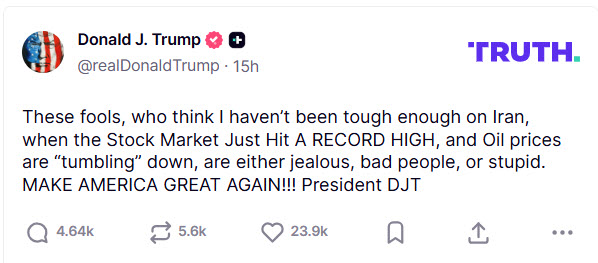
Forget Iran. All that matters to him is the stock market.
not just Israel but most of the Gulf States, blowing up Kuwait’s airport and crippling a good measure of Qatar’s liquid natural gas refining capacity that will take five years to bring back on line.
Late last month, the president said on social media that Iran’s uranium…
“will be unearthed by the United States… in close coordination and conjunction with the Islamic Republic of Iran, plus the International Atomic Energy Agency, and DESTROYED.”
He is now saying,
“It is a little hard, though, when you say that somebody wants it, other people have it, other, adjoining states have it, and you’re not letting them have it for purposes of electricity and things like that. It’s always a little tough. You have to use a little common sense.”
No need to worry about the uranium, buried under the rubble of the bombing run of last July. ”Nobody is going to get that for a long time, unless we want to get it”, the president told reporters at a G7news conference:
”You could make the case, why are you even bothering, because it’s not really valuable.”
Has he read the document?
He was two days from signing the understanding with its astonishing pledge to “plan” how to resurrect Iran with 300 billion U.S. dollars when he decreed, perhaps unable to face the humiliation of his massive blunder:
“We are not investing any money in Iran, by the way. The rumor got out there yesterday, it was ridiculous. We have the right to go in some day and do, if I want to do something or if somebody wants to do something. But we are not investing any money. We have no obligation to invest any money in Iran.”
That’s matched by the breathtaking naïveté of JD Vance saying — after we had decapitated Iran’s leadership, killed thousands of their people, and destroyed their military assets:
”The coolest thing about the progress we’ve made over the last few weeks is that you see people within the Iranian system — senior leadership, even IRGC officials – saying you know what? We may have some animosity, we may have some mistrust, but we recognize that the way that we have done business with the United States for 47 years is a mistake. Let’s try something else.”
The outcome
That Trump fell for Netanyahu’s three-card monte at the White House, committing Secretary of Lethality Hegseth’s U.S. military to attack Iran because it “sounds good to me”, is viewed as America’s biggest foreign policy disaster since Iraq. Iran is now considerably stronger than before the war began. It has learned that the blows of the mighty United States can be withstood, its missile and drone stockpiles having largely survived, with nothing to stop its rule of the Hormuz Strait, closing or opening it at will. Allied with Russia and China and about to be economically rescued by Trump’s “deal”, Iran will become a much bigger problem.
The United States has learned once again — soon probably to forget once again — that a nation of size cannot be bombed into submission.