Is Mark Zuckerberg’s Meta (Facebook et al.) in Decline?
Some in the media seem to think so. Jun 12 2026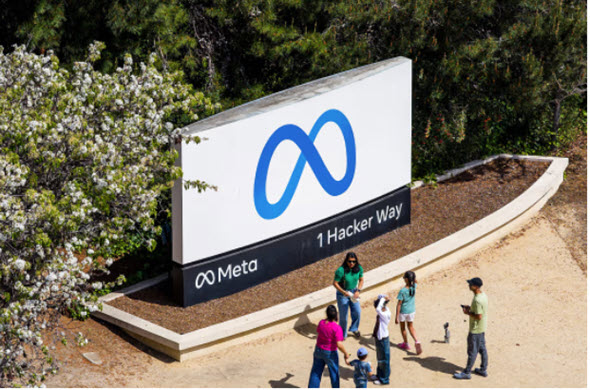
Maybe it’s retribution for how much advertising income Facebook drained from the media over the last two decades, but otherwise why has there been a flurry of news articles lately suggesting that Meta Platforms (Facebook, Instagram, WhatsApp) is past its prime. “There’s a moment when internet companies get the stink of death on them”, begins an opinion piece in The New York Times. “For Meta that time is now”.
It’s a tough argument. Facebook still has three billion users, which is even more than the populations of China and India combined. Last year Meta brought in $201 billion in ad revenue. That is 20% of the entire advertising market, scooped up by this one company. But the media noticed that for the first time the member count dipped slightly in April.
Nevertheless, Gen Z arrivers — born in this century’s first decade — may have Facebook accounts but they frequent them less than older generations, preferring Instagram and TikTok and SnapChat for connection with friends. They see Facebook as a platform for older people.
Triggering suspicions of decline was management in April telling employees that 8,000 in their midst – fully 10% of the company’s near 79,000 workforce — would be shown the door. All were made to wait in anger and angst until May 20 to learn if they were booked for the guillotine. In the meantime, to their furor, the company had employees’ keystrokes, mouse movements, and click locations recorded in order to train A.I. to do their jobs when they were gone. On the big day, everyone was told to work from home. Evidently, the C-suite didn’t want any tearful partings.
Is Meta in trouble financially? Hardly. The company had just posted record revenue — after all these
years a 33% increase over the first quarter of 2025. Its annual revenue per employee is a stunning $2.5 million, which makes the layoffs seem cruel. Severance was generous, though, with 16 weeks of pay plus two additional weeks for every year an employee had been with the company.
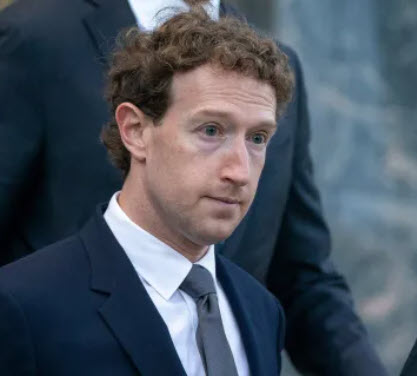
Mark Zuckerberg, Meta Platforms' CEO
But for CEO Mark Zuckerberg, their removal would free up money for his all-out quest for Meta to arrive at A.I. “superintelligence”, the level at which A.I. renders humans obsolete. Zuckerberg said another 7,000 personnel would be re-assigned to A.I. development.
Zuckerberg saw Facebook as a way for people around the world to connect with each other. It has undeniably done so, but it has also attracted some of humanities worst elements, creating a conduit for sex trafficking, bullying and shaming by school kids that has led to suicides, scams that have fleeced people of life savings, disinformation by countries such as Russia out to interfere with our elections, and so on. To give you an idea of the scope, when the Consumer Federation of America filed a complaint about Meta misleading users about preventing scams, the tech giant replied that in 2025 it had deleted 159 million scam ads in 2025, and taken down nearly 11 million scam accounts.
In 2018 investigative media exposed the Cambridge Analytica scandal. It had acquired data about up to 87 million Facebook subscribers which it exploited by gathering personal information from them and the links to their friends.
For whatever good it does, Facebook has a parallel record of malfeasance. Internet providers have for 30 years been given immunity from legal responsibility for content placed on their sites by others. Originally meant to encourage free speech and protect online platforms from being sued into extinction, that freedom is now being challenged.
In March, a jury in Los Angeles held Meta and Google’s You Tube liable for a now-20-year old woman’s mental health distress as a child owing to their deliberately addictive techniques such as “infinite scroll” and recommendations by algorithm. Also in March, a jury in New Mexico in a case brought by the state attorney general found Meta liable for $375 million for its failure to shield young people from online hazards. The Wall Street Journal, ever standing up for business, dismissed the first case as the companies having no responsibility for someone’s “personal troubles” and called the citizenry suing big business as “a shakedown”. But a war is brewing. Zuckerberg’s Meta, and its practices of maximizing engagement by young people, is facing thousands of cases waiting for their moment in court.
sputnik momentMr. Zuckerberg and others were unprepared for OpenAI’s ChatGPT bursting upon the scene in late 2022, as was the whole of Silicon Valley. Meta’s first attempt at its own large language model performed poorly. The company re-started and has been playing urgent catch-up since, while rivals OpenAI’s and Anthropic’s offerings have soared. Last year Zuckerberg hired Alexandr Wang, then 28 and billed as the world youngest self-made billionaire at age 24, to lead the Superintelligence Labs for a salary in the millions, but Wang has several times postponed release of the labs latest work.
Mr. Zuckerberg intends to spend $135 billion on A.I. infrastructure this year alone. Even if market research outfit 
Massed servers at a data center.
eMarketer is correct that revenue could reach $243 billion this year — a huge jump from $201 billion last year – which when reduced by operating costs ($83 billion last years), means Meta must borrow, with $59 billion in long-term debt on Meta’s balance sheet already. The Wall Street Journal’s “Heard on the Street” column said “The spending growth looks increasingly unsustainable”.
This has investors worried. They have already seen Zuckerberg’s erratic management style. When headcount peaked at 87,000 in 2022, he cut 11,000 slots. Then in 2023, declaring it the “year of efficiency”, he cut 10,000 more to 67,000 at year end. But headcount was back up to 79,000 before the 8,000 layoff. He seems to hire and fire in massive waves without analysis of what useful these legions of bodies will be doing nor regard in layoffs to what they’ve been doing.
going for brokeInvestors looking at Mr. Zuckerberg’s $135 billion A.I. spending plan surely have in mind his fantasy immersion in what he called the “metaverse”.
Mark Zuckerberg's oft-stated goal for Facebook was connection — to bring people together. But he wanted to take that from a flat screen that scrolls posts from friends and family to a three-dimensional world of interaction where those same people, in avatar form, can come together to talk and do things jointly. Convinced he had seen the future, in 2022 he assigned thousands in the company to create this alternate world. By draining the company of billions of dollars and causing its market value to plunge by 70% over that year, he had investors spooked.
Zuckerberg believed that we will live in the metaverse, an immersive realm accessed by wearing virtual reality headsets where we create cartoon-like avatars to represent ourselves. There, we will have our avatars while away the hours in any of a number of "worlds" for entertainment, socializing, adventure, business, where we meet with co-workers, family, or have chance encounters with people from around the globe who have strapped in at the same time and have sent their avatars roaming, too.
There was never much interest. Headsets cost up to $1,500. Those who gave a try to Zuckerberg’s world tended not to return. But the spending went on. He was defiant, saying people would…
"look back decades from now and talk about the importance of the work that was done here".
In March of this year he announced that people would no longer be able to access the the immersive world through headsets, which defeated his 3D world. There was nothing left but remnants on cell phones.
In all, Zuckerberg had blown through a jaw-dropping eighty billion dollars.
In any other company, he would have been fired long before $80 billion had been expended. But Mark saw to it long ago how he could not be uprooted from his creation. It’s a public company, but Zuckerberg controls Meta through a dual-class share structure:
Class A shares (one vote each) are available to the public but Class B shares are held by Zuckerberg and a small group of insiders and they have 10 votes each.
This structure gives Zuckerberg approximately 57–60% of Meta’s total voting power even while owning only around 13% of the total shares outstanding. In practical terms, no shareholder vote can override him.
From starting up in a Harvard dorm room on a bit of software that let students compare two photos of incoming freshmen and decide who was better looking (hence the peculiar name “Facebook”), and onward to $279 Billion in wealth.
Please subscribe if you haven't, or post a comment below about this article, or
click here to go to our front page.